
6 Real Estate Tax Strategies and Tips Every Investor Should Know
Many people invest in real estate for its enormous tax benefits. Unfortunately, too many investors squander their potential tax savings by following...
4 min read

Many people buy rental properties for the steady cash flow or the long-term appreciation, but one of real estate’s biggest advantages often goes overlooked: the tax benefits. In this article, we’re sharing 10 rental property deductions that could save you thousands come tax season and help you scale your real estate portfolio even faster!
Disclaimer: This article is for informational purposes only and does not constitute tax, legal, or financial advice. Tax laws vary by jurisdiction and are subject to change. Rent to Retirement does not provide personalized tax guidance. Consult a qualified tax professional or CPA before claiming any deductions or making decisions based on this content.
Summary:
Many landlords, especially new ones, aren’t aware of the tax deductions they can take, leading them to leave thousands of dollars on the table each year. Missing these deductions not only lowers your overall return on investment but also makes it harder to scale your portfolio. Every dollar you pay in taxes is a dollar you can’t put toward buying your next rental property!
Want to keep more of your rental income? Here are 10 of the best rental property tax deductions you can take advantage of:
Depreciation is a real estate tax strategy that allows you to deduct your property’s “value” (its cost basis, excluding land) over 27.5 years. There’s also bonus depreciation, which allows you to frontload this deduction.
Browse cash-flowing turnkey rentals with forecasted post-depreciation returns!

Many investors hire a property manager when investing out of state. Others hire one just so they don’t have the hassle of self-managing their rentals. In either case, all property management fees are write-offs!
The national average for landlord insurance is $1,516 per year, or roughly $126 per month. Premiums have risen significantly over the last few years, but thankfully, you can deduct them on your taxes!
Mortgage interest is tax-deductible, whether you have 5%-down financing on a Rent to Retirement new build or a 20%-down conventional mortgage.
Did you know Rent to Retirement offers 5%-down financing on select new builds?

The fees for forming and maintaining your LLC are tax-deductible, which means you get protection for your rental property and a tax write-off for these costs.
If you need LLC formation services, NCH will make sure your property or business is set up properly!
Repairs and maintenance costs can quickly mount and eat into your cash flow, but the good news is that they are tax-deductible. Want to save more on repairs and maintenance? Buy a turnkey property! Since these rentals are either newly built or recently renovated, they often require less upkeep than older properties.
If you meet with a CPA for quarterly tax preparation, you can deduct those fees on your taxes. Even the money you spend filing your taxes can count as a write-off.
Real estate investing books, courses, and other educational resources, such as the Rent to Retirement Academy, are all tax write-offs. Even your travel and ticket fees can be written off when attending a conference or event.
Join the Rent to Retirement Academy to fast-track your rental portfolio’s growth!

Unlike routine maintenance and repairs, major line items like new systems, additions, and upgrades are often depreciated—not given a year-one write-off. But you can still claim their full value over the IRS-approved depreciation schedule (can be as little as five years, or sooner with bonus depreciation).
Property taxes on single-family homes increased by 3% in 2025. Fortunately, you can deduct them on your tax return!
Many investors calculate their rental property returns without factoring in depreciation, which can completely change how your investment performs.
At Rent to Retirement, we forecast multiple returns on our turnkey rentals, including one that accounts for depreciation, so you can better understand the property’s total potential.
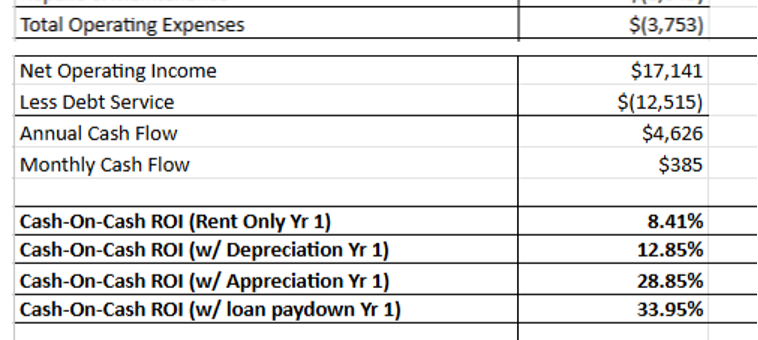
In the above example, your cash-on-cash return jumps 50% when factoring in depreciation, a paper loss!
Although there are dozens of rental property expenses you can legally write off, you can’t deduct any of the following:
Let’s say you own a rental property that makes $500 in monthly cash flow. The property itself (not including land) has a cost basis of $300,000, which gives you a depreciation deduction of $10,909 per year. In this scenario, that paper loss is much higher than your annual cash flow ($6,000), meaning it completely negates the taxes you would need to pay on your profits. Plus, you’ve got a leftover deduction of nearly $5,000 that you can use to offset other passive income!
It’s important to know that you can only use these rental property tax deductions to offset your passive income—not active income from your W-2 job—unless you meet the material participation requirements for real estate professional status (REPs).
To qualify for REPs, you must meet three requirements:
This is difficult to achieve without having a large rental portfolio or using a more hands-on investment strategy like short-term rentals!
Rental property investing is a great way to build long-term wealth, but maybe you don’t want to spend hours each week screening tenants, communicating with tenants, coordinating repairs, or chasing rent payments.
Create more “passive” income with turnkey rentals instead. These are new or renovated properties that come with property management already in place, and they often require less maintenance than other properties. Meanwhile, you get all the same tax deductions you would with any other rental property—including depreciation!
Many of the costs associated with your rental property are tax deductible. These expenses include property management fees, landlord insurance, mortgage interest, LLC and legal fees, maintenance and repairs, tax preparation fees, educational resources, and property taxes. With depreciation, you can even deduct the cost basis of your property (excluding land), as well as any property upgrades and improvements!
You can maximize your rental property tax deductions by taking full advantage of depreciation and writing off expenses like mortgage interest, landlord insurance, property management, and more!
Yes! If you’ve owned a rental property for five years but haven’t taken any depreciation deductions, you can claim five years of “catch-up” depreciation on your next tax return and take the normal annual deduction going forward.

Many people invest in real estate for its enormous tax benefits. Unfortunately, too many investors squander their potential tax savings by following...

Many people invest in real estate for its enormous tax benefits. Unfortunately, too many investors squander their potential tax savings by following...

Owning real estate has tremendous benefits and can be a great source of acquiring wealth. Additionally, there are numerous tax-related deductions...