
4 min read
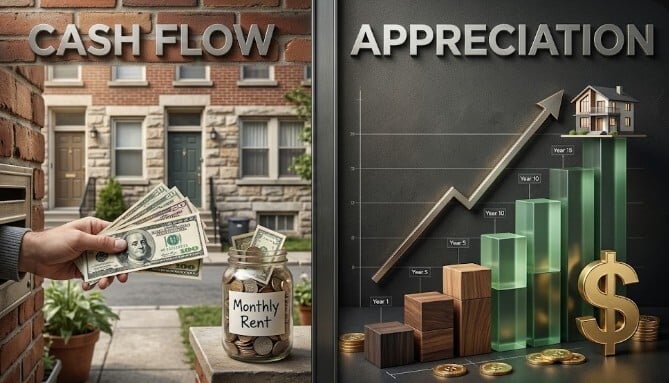
Cash flow or appreciation is one of the biggest debates in real estate investing, but there’s no one “right” answer for every investor. In this article, we’ll dig into the mechanics of each strategy so you can choose the one that best aligns with your investing goals, timeline, and risk tolerance!
Summary:
- Cash flow is what you make from your rental property each month after deducting all expenses (including your mortgage payment).
- Appreciation is an increase in your property’s value. Market-driven appreciation occurs naturally over time, while forced appreciation comes from property improvements.
- Rent to Retirement helps investors generate day-one cash flow and build long-term wealth by prioritizing markets with high rent-to-price ratios and strong underlying fundamentals.
What Is Cash Flow in Real Estate?
Cash flow is the amount a rental property makes after all expenses have been deducted from the gross rental income. These expenses include not only your principal and interest payments, landlord insurance, and property taxes, but also property management fees, maintenance costs, and vacancy allowances. Think of this as the actual profit a rental property produces.
What Counts as a Cash Flow Property?
A cash flow property generates enough rental income to comfortably cover all expenses, allowing you to make a profit. You typically find these types of rental properties in more affordable markets with strong rent-to-price ratios.
Browse cash-flowing turnkey rental properties with property management in place!

What Is Appreciation in Real Estate?
Appreciation is how much a property’s value increases over time. For example, if you buy a rental property for $250,000 and it’s worth $300,000 in five years, it has appreciated $50,000, or 20%. Appreciation can be market-driven (occurring naturally) or forced (through improvements).
Market Appreciation vs. Forced Appreciation
Natural, market-driven appreciation occurs due to external factors (often outside the investor’s control), such as population growth, job creation, or supply constraints. Forced appreciation occurs through value-add improvements, such as renovations, additions, and conversions. In commercial real estate, investors can also force higher property values by improving management and increasing NOI (net operating income).
Cash Flow vs. Appreciation: Key Differences at a Glance
Cash flow and appreciation differ in how they occur, how long they take to occur, and how they make you money. Here are the core differences between the two strategies:
|
Factor |
Cash Flow Strategy |
Appreciation Strategy |
|
Primary return driver |
Monthly rental income |
Property value growth over time |
|
Predictability |
High — can be modeled from day one |
Lower — often market-dependent |
|
Typical markets |
Affordable, high rent-to-price ratio |
High-demand, higher-priced locations |
|
Entry cost |
Lower |
Higher |
|
Risk profile |
Lower — income from day one |
Higher — relies on future price growth |
|
Time horizon |
Short- and long-term |
Long-term |
|
Vacancy impact |
Managed through cash flow buffer |
Amplified by negative cash flow |
|
Best suited for |
Income-focused investors, retirees living off rental profits |
Equity-focused investors who want to grow net worth, not just monthly income |
Which Makes You More Money: Cash Flow or Appreciation?
The answer depends on several variables, such as the market, rent, expenses, and the rate of appreciation assumed. Historically, sustained above-inflation appreciation is rare, so buying a rental property in a market that supports cash flow and appreciation is crucial.
Looking for cash flow and appreciation? Rent to Retirement offers turnkey rentals in high-growth, high-rent markets!

The Appreciation Trap
Sacrificing cash flow to chase high, unpredictable returns from appreciation is sometimes described as the “appreciation trap.” It turns investors into speculators and can lower their total return on investment. Even if you believe home values will increase in your market, you should ensure that the property also produces positive cash flow so you’re not losing money each month.
How to Calculate Cash Flow on a Rental Property
You can reasonably forecast your rental property’s cash flow, as well as other key metrics, by estimating your rental income and tallying your expenses.
The Cash Flow Formula
To calculate cash flow, subtract all monthly expenses (including debt service) and allowances from your gross monthly rental income.
Let’s say you own a rental property that makes $2,200 in gross rental income each month, and you have a mortgage payment (PITI) of $1,500, property management fees of $220, a maintenance allowance of $120, and a vacancy allowance of $120. Here’s how you would calculate your cash flow:
$2,200 (gross monthly rental income) - $1,960 (total monthly expenses) = $240 (cash flow)
Use Rent to Retirement’s free rental property calculator to run the numbers in minutes!
Cash-on-Cash Return
Cash-on-cash return measures the annual return on your actual cash investment, making it a useful metric when comparing cash flow properties. To calculate cash-on-cash return, divide your annual pre-tax cash flow by the total cash invested.
For example, if you put a 20% down payment on a $200,000 property that brings in $3,000 in annual cash flow ($250/month), here’s how you would calculate your cash-on-cash return:
$3,000 (annual pre-tax cash flow) / $40,000 (cash invested) = 0.075 or 7.5% (cash-on-cash return)
Which Strategy Is Right for You?
The right investment strategy for you depends on your income needs, risk tolerance, timeline, and available capital. Markets with greater appreciation potential may also have higher home prices and require more money upfront, while markets with higher rent-to-price ratios often have more affordable properties.
Prioritize Cash Flow If…
You’re looking for immediate returns in the form of consistent monthly income. Target cash flow properties in strong rental markets with high rent-to-price ratios, but keep in mind that some properties have lower upside than more appreciation-focused investments.
Prioritize Appreciation If…
You have a longer time horizon, higher investing risk tolerance, and more capital. Appreciation is difficult to predict, so you’ll want to be comfortable with the possibility that home values don’t increase as much as you expect.
The Best Real Estate Approach?
For many investors, the best answer to “cash flow or appreciation?” isn’t one or the other—it’s both. Rent to Retirement’s IDEAL framework helps investors build wealth through five key benefits: Income (cash flow), Depreciation (tax deductions), Equity growth (debt paydown), Appreciation, and Leverage (using debt to control an asset).
We prioritize day-one cash flow but target markets that allow appreciation to follow. This helps you build an income-producing portfolio today and create long-term wealth!
Cash Flow vs. Appreciation FAQs
What’s Better, Cash Flow or Appreciation?
Neither cash flow nor appreciation is inherently better than the other. The right option for you depends on your investment goals, timeline, and risk tolerance. However, cash flow is measurable and somewhat controllable from day one, while appreciation is often market-dependent and difficult to predict. For this reason, cash flow is usually the more reliable goal for investors, with appreciation serving as a secondary benefit.
How Do You Explain Cash Flow to a Beginner?
Cash flow is simply the amount of rental income left over after you’ve paid all monthly expenses, including your mortgage. If your tenant pays $1,500 a month, and your monthly expenses amount to $1,300, your monthly cash flow is $200. Positive cash flow means the property is paying you; negative cash flow means you are losing money.
How Much Appreciation Can I Expect on a Rental Property?
Historically, U.S. home prices have increased in line with inflation and even outpaced it at times. Periods of rapid appreciation do occur, but they are difficult to predict and should not be the basis for an investment decision.
Can a Property Have Both Cash Flow and Appreciation?
Yes, and the strongest portfolios have properties that produce positive cash flow and long-term appreciation. Rent to Retirement targets markets that offer both: strong rent-to-price ratios for immediate income and solid market fundamentals to help you build long-term wealth!